Inference — kinds, presentation, and the error policy
Kinds gives the relation: which kinds exist and which judgments hold. This page gives the algorithm: how a kind is actually assigned to every node of a program, how the presentation of a chart — pane, scale, guides, colour, parameter UI — is derived from those kinds rather than configured, and what happens when something does not type.
Three properties make the algorithm worth specifying precisely, rather than leaving it as an implementation detail. It is principal (the kind it synthesizes is the least one the program admits, so there is never a choice to make), it is deterministic (the same source always yields the same kinds, which is what lets two engines emit byte-identical code), and it is total (every editing state, including a half-typed line, gets a kind or a precise error — never a silent failure).
New here? Start with Guide §5 — Kinds: types that carry meaning → for the teaching version, then return here for the algorithm.
Two modes
Inference is bidirectional: it reads the same typing rules in two directions.
Synthesis — Γ ⊢ e ⇒ κ — is the default, bottom-up mode. It produces the smallest
kind the expression admits. Leaves synthesize their exact kind (close ⇒ price,
14 ⇒ lit, "hi" ⇒ string); introductions synthesize their structure (a record literal, a
scene, a constructor); eliminations synthesize by computing — a call, a projection, a
match, a delay, a resample, and every arithmetic node, which asks the dimensional algebra
for its result kind.
Checking — Γ ⊢ e ⇐ κ — is the top-down mode, and it runs only at sites of
consumption, where an expected kind already exists:
| Consumption site | What is checked |
|---|---|
| a call argument | eᵢ ⇐ πᵢ — the parameter’s declared kind |
a record field, a with update |
vⱼ ⇐ κ_field |
| an output statement | plot e ⇐ presentable · mark s ⇐ signal|dir · fill a..b ⇐ ordered-scalar · color bars: ⇐ signal|dir|color |
an APP-plane init value or update arm |
field ⇐ the Model’s kind |
| a lambda | (p⃗) -> body ⇐ (π⃗)→ρ — a lambda never synthesizes; it is checked against the function kind the higher-order kernel demands |
That last row is also what disambiguates the arrow: (x) -> x * 1.1 is a lambda exactly
when its position expects a function, and a tween pair otherwise. Disambiguation is a
consequence of the mode, not a separate rule (see Grammar).
Subsumption is confined
The coercion rule — “an a may be used where a b is expected if a ≤ b” — fires only at
the boundary between the two modes. To check e ⇐ κ: synthesize e ⇒ κ', then demand
κ' ≤ κ. Silent if the edge is ≤safe; a warning with a quick-fix if it is ≤lossy;
[ErrDim], [ErrArg] or [ErrPlot] — according to the position — if κ' ⊀ κ.
Coercion never fires during synthesis. A node is never spontaneously widened; its synthesized kind stays the lowest one known.
Why confinement is load-bearing. Suppose subsumption were allowed in synthesis. Then
x = close - closecould synthesizelevelor, by the lossy erasure edge,quantity. Both are derivable. Butplot xreads the presentation registry at the kind:levelgives a pane centred on zero,quantitygives a fallback auto pane. One program, two valid outputs, two different compiled artifacts — and the guarantee that the editor’s preview matches the shipped module (I7) would be gone. Confinement is what makes “the kind of an expression” a function rather than a choice.
Principality
With synthesis defined as above, every expression has a principal kind: the unique
smallest kind it admits. The proof is a one-line induction — each leaf synthesizes exactly,
each node combines its children’s minimal kinds with either ⊔ or the dimensional algebra
(both of which return a unique result, verified by enumeration), and the only widening rule is
excluded from the mode. So the synthesized kind is the least one, and checking ≤ at each
consumer is then complete.
The multi-site case. A field initialized to na synthesizes ⊥ at that site — but its
kind is not stuck there: the principal kind of a record field is the join over all its
construction and assignment sites. In the APP plane, a Model field written picked: na in
init and picked: key (a string) in one arm of update has kind string, with na
remaining a legal runtime value of that field (⊥ ≤ string). The fixpoint converges in one
pass because the kinds being assigned never depend on the record itself. Declaring
record Model { … } up front is the same thing written explicitly.
Termination and determinism
The algorithm is a single bottom-up pass over the topologically sorted graph. It
terminates because the lattice is finite by family and of finite height, the graph is acyclic
(causality guarantees that), and ⊔, ⊓ and the algebra are all O(1) — there is no fixpoint
iteration and no store of unification variables anywhere.
It is also confluent: a node’s synthesized kind depends only on the kinds of its inputs,
and ⊔ is commutative and associative, so the result is independent of which topological
order was chosen. Inference is therefore a deterministic function of the graph — the same
program always yields the same kinds, hence the same emitted module. This is one of the
foundations of the interpreter ≡ WASM byte-equality (see
Compiler and runtime).
Bounded polymorphism, resolved then forgotten
The catalogue is full of kind-preserving families: ema, sma, sum, highest, change,
stat.stdev — each written (src: α ≤ quantity, len: lit) → ρ(α). This is the only
polymorphism in v1, and it is deliberately shallow.
At each call site, α is resolved to a closed, monomorphic kind: α := the join of the
kinds synthesized for the arguments in α positions; then α ≤ quantity is checked
([ErrArg] otherwise); then the return kind is the family’s shape instantiated at that α.
For difference families, the shape is the δ derived from the frozen ± algebra:
δ(price) = level.
a = ema(close, 20)              // α := price      ⇒ price
b = ema(rsi(close, 14), 9)      // α := osc(0,100) ⇒ osc(0,100)   — smoothing preserves the kind
c = change(close, 5)            // δ(price)        ⇒ level
d = change(rsi(close, 14), 5)   // δ(osc)          ⇒ osc, centred on 0
α is resolved and then forgotten. It is not a unification variable that persists across
the program, so two sites can never contradict one another, and the “no general unification”
property that keeps inference a single pass survives intact.
Typing an unfinished program
An editor types a program that is being written, not one that is finished — so the algorithm assigns a kind to every editing state.
An unbound name (you are halfway through typing it) and a syntax hole (a parse error node)
both synthesize a kind hole: a contained ⊤ that emits exactly one diagnostic
([ErrUnbound]) and does not poison its siblings.
From that follows the typable cone: the largest sub-graph in which every node, and every
transitive input of every node, is free of ⊤ and free of holes. Live preview evaluates
exactly that cone and renders the rest as --. A local mistake therefore never blanks the
whole preview — a correct program has a cone equal to the whole graph, and a program with one
unbound name still previews everything that does not depend on it.
The cone is a strictly editing-time artifact: a ⊤ in a consumed position is still a hard
failure to emit code. The byte-identity guarantee is untouched.
Incremental re-typing
On an edit, only the changed node and its downstream cone of kind consumers are re-synthesized; every other node’s kind is memoized under the pinned node identity that the compiler already maintains for hashing and common-subexpression elimination. Because the graph is acyclic and the lattice is monotone and finite, this converges in one downward pass.
Incremental re-typing is observationally equal to a full re-inference — it is the same function, memoized — so it can never disagree with the shipped module. It is what keeps the sub-16 ms editing budget, together with incremental parsing.
Presentation is inferred, not configured
Here is the payoff of a kind system that tracks meaning. A kind already says what a value is; so it also says how it should be shown. That is why the first program anyone writes is one line long and needs no options:
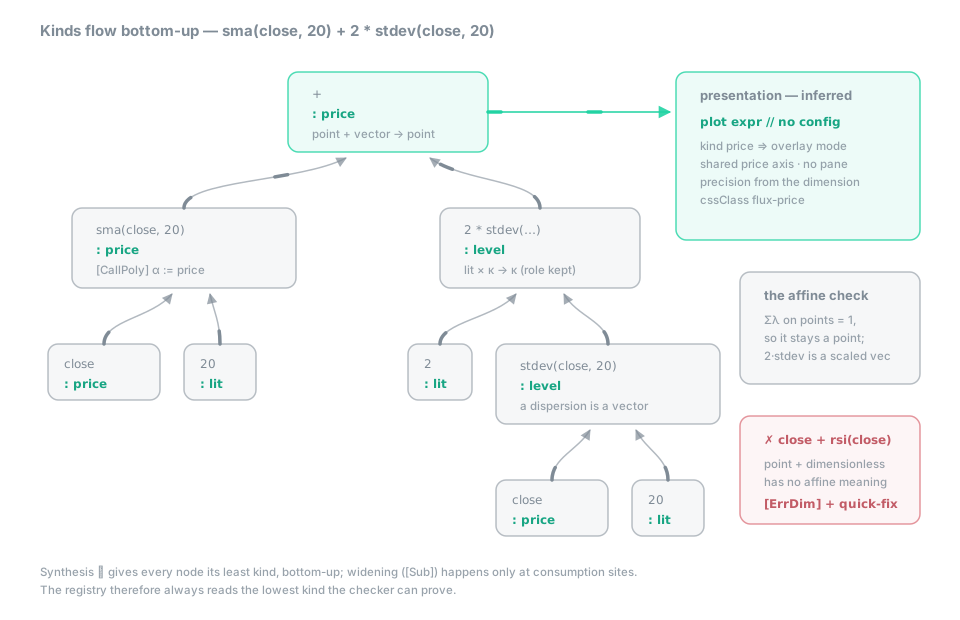 Figure — kinds flow bottom-up;
 stdev is a dispersion (a vector), a literal multiple keeps its role, and point + vector = point lands the whole expression on the price axis — so it overlays.
The compiler derives a registry entry from the kind, and refines it with metadata from the operation itself:
registry := merge( reg(kind), opMeta(expression) )reg(kind) supplies the defaults; opMeta refines them (an rsi adds its 30/70 guides). The
complete default table:
| Kind | Mode | Scale | Reference lines | CSS class |
|---|---|---|---|---|
price |
overlay, on the price axis | shared price scale | — | flux-price |
level |
own pane | symmetric around 0 | 0 |
flux-level |
osc(lo,hi) |
own pane | fixed [lo,hi] |
midpoint, plus operation guides (rsi → 30/70) | flux-osc |
ratio |
own pane (log optional) | around 1 | 1 |
flux-ratio |
volume |
own pane | signed-aware ([0,max] when non-negative) |
0 |
flux-volume |
pv |
own pane | auto | 0 |
flux-pv |
signal |
marks / fills / bar colouring — never a line | — | — | flux-signal |
dir |
bar colouring / marks — never a line | — | — | flux-dir |
slope |
own pane | symmetric around 0 | 0 |
flux-slope |
barspan |
own pane (a count of bars) | [0,max] |
0 |
flux-barspan |
barindex |
x-axis position / anchor — never a series | — | — | flux-barindex |
composed dimension (P², P²·V⁻¹) |
own pane, auto-labelled by its exponents | auto | — | flux-num |
angle |
style channel, or a pane on [-π,π] |
[-π,π] |
0 |
flux-angle |
depth |
projected on the z axis in 3-D; flattened in 2-D | host z space | — | flux-depth |
time / duration / period |
x axis / annotation | — | — | — |
decimal(scale) |
follows its dimension; values formatted to scale decimals |
its dimension | its dimension | its dimension |
record{…} |
exploded field by field | per field | per field | per field |
vec(κ, N) |
reduced or indexed at the element kind κ; or rendered as a representation (a volume profile is a histogram) |
inherits κ |
inherits κ |
inherits κ |
color, clock, string, ui |
consumed by their channel — never plotted | — | — | — |
num / quantity |
fallback pane — you see the erasure | auto | — | flux-num |
⊤ / ⊥ |
not presentable — [ErrPlot] |
— | — | — |
The CSS class is part of the derivation, not a detail of the theme: the host stamps it on the rendered series, so a stylesheet can restyle every oscillator on the chart without any script naming a colour. It is the one place where “the presentation is inferred” reaches all the way out to the page.
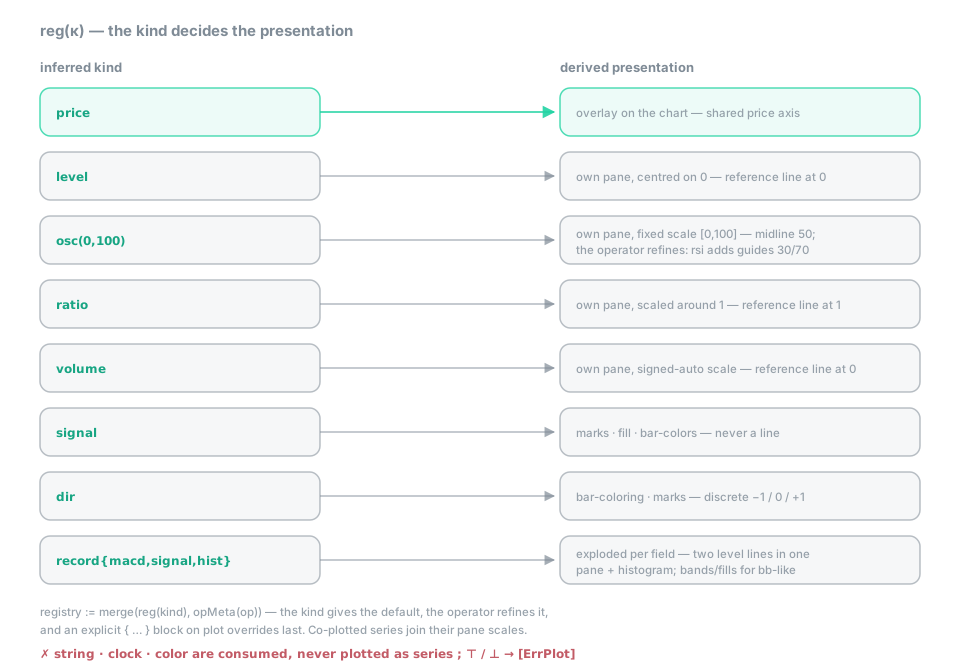 Figure —
 reg(κ): each kind carries its own pane, scale, guides and CSS class, and the registry is merged with the operator’s own metadata. A string, a clock and a color are consumed, never plotted as a series; ⊤ and ⊥ are [ErrPlot]. None of it was configured.
Four rules complete the picture:
- Overlay if and only if the value shares the price axis. Otherwise it gets a pane.
- Co-plotting joins scales. Two series in one pane take the
⊔of their bounds; if that join lands onquantity, you get[WarnBranchDim]and a suggestion to split the pane. (Apriceoverlay next to aratiopane is not a mix — it is two panes, and it warns about nothing.) - The final kind decides.
level + price → price, so the expression overlays. - Reference lines from convention live in
opMeta, not in the kind.osc(0,100)gives a midline; thatrsiconventionally marks 30 and 70 is a property ofrsi.
A record explodes into its fields, each presented at its own kind — which is why
plot bollinger(close, 20, 2) yields three price lines plus a band, and plot macd(close)
yields a centred pane with a histogram and a signal line, with no code to say so.
Overrides — intent beats the default
Inference gives the default; the author overrides it in the plot block, and because the
system knows the kind, the override is intelligent rather than blind:
m = macd(close)
plot m.macd { overlay }                  // a level FORCED onto the chart → it gets its OWN secondary axis
plot ema(close, 20) { pane }             // a price FORCED into a pane → auto-scaled, fine
plot m.hist { style: histogram, color: if m.hist > 0 then up else down }
plot rsi(close, 14) { guides: [20, 80] } // authored reference lines, kind-checked as level|osc

ich = ichimoku()                          // sourceless: it reads high/low/close itself
plot ich.chikou { offset: -26 } // a DISPLAY shift: it moves the x position, never the value| Override | Effect |
|---|---|
{ overlay } / { pane } |
force the mode. Forcing a level or osc to overlay gives it a secondary axis — the system knows a shared price scale would make it invisible. |
{ scale: own | shared } |
choose the scale. { scale: shared } on a level raises [WarnScale]. |
{ style: … } |
the render glyph — a closed, host-allowlisted set: histogram, columns, stepline, area, circles, cross (a line is the inferred default). |
{ color: … } |
a per-bar colour expression. |
{ guides: [ … ] } |
authored reference lines, kind-checked. |
{ title }, { precision }, { width } |
presentation metadata. |
{ offset: ±lit } |
a display shift along x, bounded. It moves where a value is drawn, never which data it read — causality lives at the data index, so drawing into the future is a rendering choice, not a look-ahead. |
Parameter UI is derived the same way: an input(…) synthesizes its kind, and the kind gives
the widget (a numeric field with a range, a source picker, a boolean, an enumeration), with
title:/group:/tooltip: as optional metadata. An accessibility descriptor is derived from
the kind as well, so a plotted series is announced meaningfully without the author writing a
label.
What may be presented at all
Presentation admissibility is a judgment like any other, decided per kind, and enumerated exhaustively:
| Judgment | Admits | Rejects |
|---|---|---|
[Plot] |
price, level, osc(·), ratio, volume, pv, signal, slope, barspan, num, quantity, angle, depth, composed dimensions, a decimal of a plottable dimension, a record (exploded), a vec of a plottable kind |
string, time, duration, period, barindex, dir, color, clock, variant, ui, an irreducible raw vec, ⊤, ⊥ → [ErrPlot] |
[Mark] |
signal, dir |
everything else → [ErrArg] |
[Fill] |
two operands of the same dimension, drawn from the price-like plotted set — price, level, volume, pv, ratio, osc, slope, num (strictly narrower than the ordered set) |
fill price..osc → [ErrDim]; time, duration, barindex, barspan, angle — orderable but not fillable; any categorical or structural kind → [ErrArg] |
[ColorBars] |
signal, dir, color |
everything else → [ErrArg] |
[CmpOrd] |
ordered scalars of compatible dimension and identical asset tags | dir (categorical), string, color, clock, record, vec, variant, ui → [ErrDim]/[ErrArg] |
[CmpEq] |
scalars, string, dir, color (bit equality); record, vec, variant (deep, na-aware) |
clock, ui — they are consumed, never compared → [ErrArg] |
Note the deliberate asymmetry: dir is not plottable as a line and not orderable, but
it is markable and is a legal bar-colouring channel. Its only presentation channels are
the two that make sense for a three-valued direction.
Why enumerate instead of arguing. Because the lattice is finite by family, these tables are checked by machine — every kind, and every pair of kinds, is run through every judgment. “No kind is left without a semantics” is not a claim in a document; it is a test that fails when it stops being true.
The error policy
An error is hard if and only if a load-bearing guarantee is violated — causality, totality, the firewall — or a dimensional impossibility appears in a demanding position. Everything else that is merely suspect is a warning with a quick-fix.
Hard errors
| Code | Fires when | Example |
|---|---|---|
[ErrDim] |
the dimensional algebra has no rule, or tags disagree | close + rsi(close,14) · btcUsd + btcEur |
[ErrRepr] |
same dimension, different representation tags, no explicit conversion | if c then f64Price else decPrice · duration ⊔ period |
[ErrCausal] |
a cycle with no unit delay, a non-causal resample, an unbounded lag | a feedback loop written without scan |
[ErrTotal] |
a window, capacity or iteration bound that is not a constant, or exceeds N_max |
window(close, n) where n is not const |
[ErrTotalRec] |
a cycle in the def call graph |
def a() = b() · def b() = a() |
[ErrTotalType] |
a cycle in the type-reference graph | record Node { next: Node } |
[ErrTotalMatch] |
a match that does not cover every label (or _) |
a missing arm, or an uncovered na |
[ErrFirewall] |
analysis reads a non-deterministic presentation value | rsi(live(close), 14) · now() in analysis · unseeded rand |
[ErrLen] |
two declared vector lengths are incompatible | zipping declared capacities that cannot widen |
[ErrField] |
a missing or unknown field | bb.upprer · m with { typo: 1 } |
[ErrArg] |
an argument’s kind is not admissible at that parameter | passing a color where a scalar is demanded |
[ErrPlot] |
the value is not presentable | plot time · plot someClock |
[ErrUnbound] |
an unbound identifier or a syntax hole | mid-edit — one contained diagnostic |
The APP plane adds [ErrState] for an unbounded Model field, on exactly this pattern; see
App plane.
Warnings
| Code | Fires when |
|---|---|
[WarnTop] |
an intermediate binding lands on ⊤/quantity and is never consumed |
[WarnAffine] |
an un-normalized affine combination (high + low with no /2) |
[WarnBranchDim] |
branches of an if, or two co-plotted series, have different dimensions → quantity |
[WarnLit] |
a literal outside a known bound (rsi(close,14) > 150) |
[WarnScale] |
{ scale: shared } on a kind that a shared price scale would flatten |
[WarnLossy] |
a coercion that erases a dimension or narrows a representation |
[WarnFloatKey] |
a computed floating-point value used as a collection key |
[WarnNaUpdate] |
a collection update whose function is statically na on an absent key |
Designed, not yet emitted. [WarnBoundsØ] (two osc bounds that intersect to nothing) is specified but the v1 engine has no emit-site for it yet. WarnNaNChain was an earlier documentation name for the code the engine actually raises — [WarnNaUpdate].
What an error message is
A diagnostic is human, dimensional, actionable, and linked — never a stack trace:
price + osc — you are adding a price and a 0–100 oscillator.
  close + rsi(close, 14)
          ^^^^^^^^^^^^^^ osc(0,100), a dimensionless bounded value
  A point on the price axis and a dimensionless number have no common meaning.
  Did you mean  close + atr(14)  (a price + a displacement),
  or            close * norm(rsi(close, 14))  (scale the price by a fraction)?
  → kinds: the affine substrate
A refused repaint is explained, not merely forbidden (“this would make a past value change once the bar closes”), because the refusal is the feature.
Anti-cascade. A poisoned node propagates without re-diagnosing: one root fault produces exactly one message, and the nodes downstream of it stay quiet. A single typo does not produce forty errors.
na at runtime
Kinds are static; na is the runtime story, and the two are designed to agree.
- Every comparison touching
nayieldsna— nevertrue, neverfalse. Absence is tested withis_na(x)and presence withis_some(x), bothsignal. nz(x, d)(and its sugarx ?? d) substitutes a default;max/minabsorbnapointwise, while window reducers propagate it (a window containing a hole yieldsna, matching the native oracle they must stay byte-identical to).- A
matchon a possibly-nascrutinee must cover it — annaarm or_. - Destructuring an
narecord gives every fieldna. - A NaN produced by arithmetic is
na— the kind is preserved, and it is displayed as a gap rather than as a failure. Division by zero is not an error; it is an absent value. - Internally,
nais forced to a single canonical bit pattern at every storage, hashing and serialization boundary. Nothing about that is observable in a program — it is what makes two engines agree on the bytes of a value that is not there (Memory model).
See also
- Kinds — the lattice, the sorts, the tags, the named declarations.
- Operators — the dimensional algebra rule by rule.
- Grammar — how the modes of inference resolve the arrow and the container heads.
- Time and state — causality, warm-up,
live()and the firewall in practice. - Guide §12 — Working in the editor — kind-filtered completion, hover cards, the typable cone in live preview.
- Compiler and runtime — why deterministic inference is a prerequisite for byte-identity.